Best dark sky parks in the US, on one map
124 of the best places in the United States to see the night sky, in 35 states: 109 certified International Dark Sky Parks, Sanctuaries and Reserves, and the uncertified places locals know. The colours show how dark the sky is everywhere else, so you can see how far you are from a better one. Tonight, 1 of them have a clear, moonless stretch.
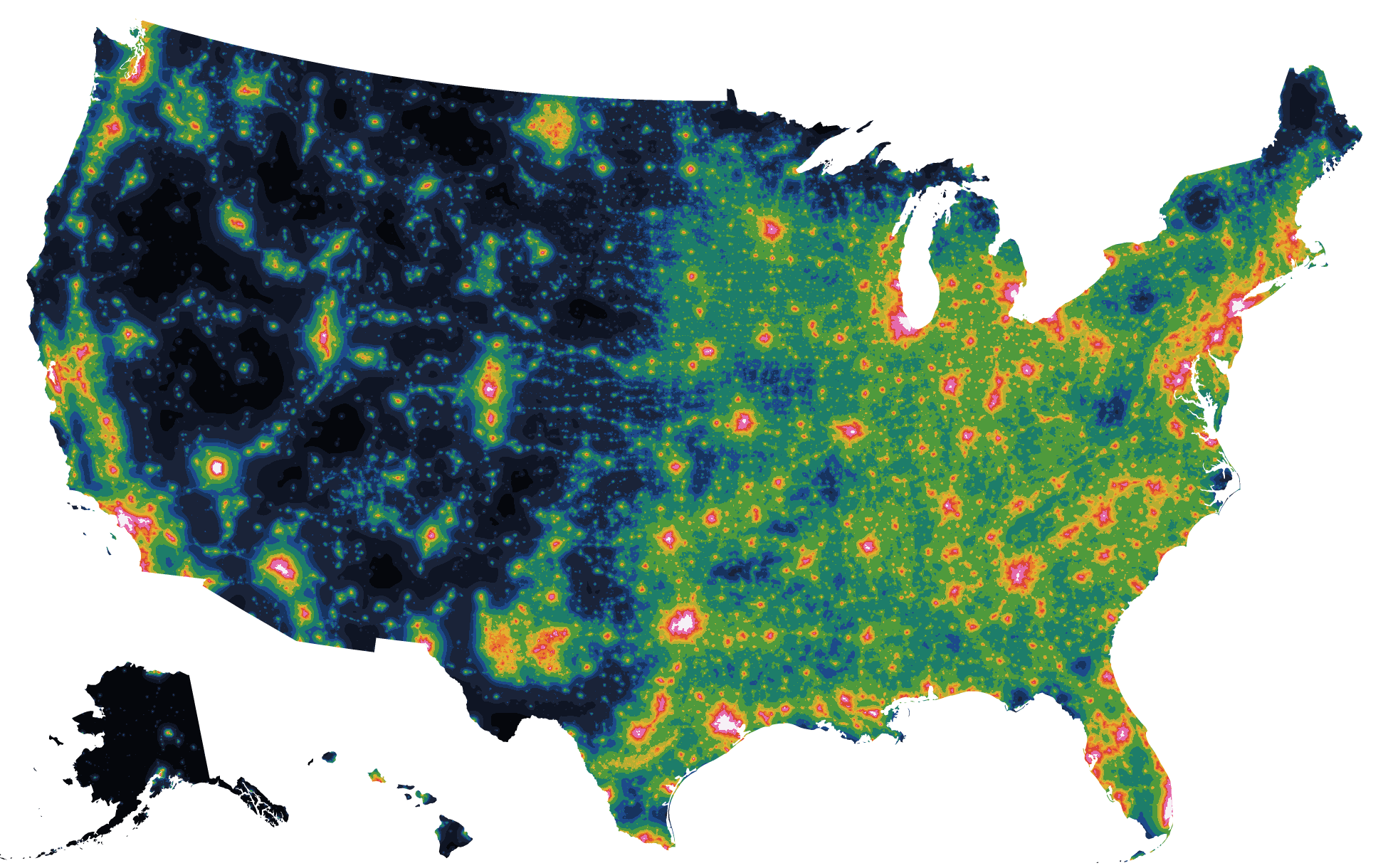
Tap a dot for a place, or anywhere else for the sky at that spot.
- 1 Pristine
- 2 Truly dark
- 3 Rural
- 4 Edge of the countryside
- 5 Suburban
- 6 Bright suburban
- 7 Edge of the city
- 8 City
- 9 Inner city
Colours are the Bortle class of the sky overhead, estimated from 2024 satellite night-lights data. Drag to move, pinch or use + and − to zoom, double-click to zoom in. How this map is made
Darkest first
What the colours mean: the Bortle scale
Nine classes, from a pristine sky (1) to the middle of a big city (9). Each tile shows the colour the class has on the map, a sketch of the same patch of sky under it, and how much of the lower 48 states it covers. 4% of the land still has a Bortle 1 sky; 54% is Bortle 4 or brighter.
- 1
Pristine
4% of the lower 48As dark as the sky gets. No glow from towns on any horizon; the zodiacal light and airglow are easy to see.
Milky Way: bright enough to cast shadows. Stars at once: 5,000 or more. Overhead: 21.99 or darker mag/arcsec².
- 2
Truly dark
26% of the lower 48A dark-site sky. Faint glow from distant towns sits low on the horizon and nothing reaches overhead.
Milky Way: detailed from horizon to horizon. Stars at once: about 4,000. Overhead: 21.89 to 21.99 mag/arcsec².
- 3
Rural
16% of the lower 48Still an excellent sky. Light domes show over towns in a few directions; overhead stays dark.
Milky Way: striking, with dark lanes visible. Stars at once: about 3,000. Overhead: 21.69 to 21.89 mag/arcsec².
- 4
Edge of the countryside
42% of the lower 48Where countryside meets suburbs. Light domes in several directions, and the sky low down is grey.
Milky Way: obvious overhead, washed out near the horizon. Stars at once: about 2,000. Overhead: 20.49 to 21.69 mag/arcsec².
- 5
Suburban
8% of the lower 48A typical outer suburb. Glow in every direction, and clouds are brighter than the sky behind them.
Milky Way: faint, overhead only, on a good night. Stars at once: about 1,000. Overhead: 19.50 to 20.49 mag/arcsec².
- 6
Bright suburban
2% of the lower 48The sky is grey to about a third of the way up. The bright constellations are complete; little else is.
Milky Way: gone, or a hint straight overhead. Stars at once: about 500. Overhead: 18.98 to 19.50 mag/arcsec².
- 7
Edge of the city
1% of the lower 48The whole sky has a grey or orange cast. Only the brighter constellations stand out.
Milky Way: not visible. Stars at once: about 300. Overhead: 18.38 to 18.98 mag/arcsec².
- 8
City
0.8% of the lower 48Bright enough to read by. Some constellations are missing stars.
Milky Way: not visible. Stars at once: about 150. Overhead: 17.65 to 18.38 mag/arcsec².
- 9
Inner city
0.2% of the lower 48The Moon, the planets and a few of the brightest stars are all that is left.
Milky Way: not visible. Stars at once: under 100. Overhead: brighter than 17.65 mag/arcsec².
The darkest of them: Bortle 1
Skies within 1% of natural darkness, where the Milky Way casts shadows.
Which states are darkest?
Share of each state's land under a truly dark sky (Bortle 1 or 2).
- Alaska96%
- Nevada78%
- Montana77%
- Wyoming65%
- Oregon65%
- Hawaii62%
- Idaho61%
- Utah61%
- New Mexico58%
- Colorado53%
At the other end, New Jersey (85%), Delaware (71%), Connecticut (64%) and Rhode Island (62%) have the largest share of land at Bortle 5 or brighter.
Certified dark sky places by type
DarkSky International certifies five kinds of place. These are all 165 in the United States on its list as of October 24, 2026, the darkest first within each kind, with the Bortle class this map gives each one.
Dark Sky Sanctuaries in the US (11)
The most remote certified places, and often the darkest, whose dark skies are the most fragile. Show all 11 on the map →
- Massacre Rim Wilderness Study Area NV · Bortle 1 · 2019
- Oregon Outback Dark Sky Sanctuary OR · Bortle 1 · 2024
- Black Gap Wildlife Management Area TX · Bortle 1 · 2021
- Cosmic Campground NM · Bortle 2 · 2016
- Rainbow Bridge National Monument UT · Bortle 2 · 2018
- Boundary Waters Canoe Area Wilderness MN · Bortle 2 · 2020
- Devils River State Natural Area TX · Bortle 2 · 2019
- Katahdin Woods and Waters National Monument ME · Bortle 2 · 2020
- Beaver Island State Wildlife Research Area MI · Bortle 2 · 2024
- Lost Trail National Wildlife Refuge MT · Bortle 2 · 2022
- Medicine Rocks State Park MT · Bortle 3 · 2020
Dark Sky Reserves in the US (2)
A dark core surrounded by populated country, where lighting policy in the surrounding communities protects the darkness of the core. Show all 2 on the map →
- Central Idaho Dark Sky Reserve ID · Bortle 2 · 2017
- Greater Big Bend International Dark Sky Reserve TX · Bortle 2 · 2022
Certified Dark Sky Parks in the US (96)
Publicly or privately owned conservation land with good outdoor lighting and night-sky programs for visitors. Show all 96 on the map →
- Big Bend National Park TX · Bortle 1 · 2012
- Natural Bridges National Monument UT · Bortle 1 · 2007
- Great Basin National Park NV · Bortle 1 · 2016
- Goblin Valley State Park UT · Bortle 1 · 2016
- Canyonlands National Park UT · Bortle 1 · 2015
- Merritt Reservoir State Recreation Area NE · Bortle 2 · 2022
- Black Mesa State Park OK · Bortle 2 · 2025
- Capitol Reef National Park UT · Bortle 2 · 2015
- Voyageurs National Park MN · Bortle 2 · 2020
- Keweenaw Dark Sky Park MI · Bortle 2 · 2022
- Capulin Volcano National Monument NM · Bortle 2 · 2016
- Big Bend Ranch State Park TX · Bortle 2 · 2017
- Clayton Lake State Park NM · Bortle 2 · 2010
- Grand Canyon National Park AZ · Bortle 2 · 2016
- Craters of the Moon National Monument ID · Bortle 2 · 2017
- Chiricahua National Monument AZ · Bortle 2 · 2021
- Salinas Pueblo Missions National Monument NM · Bortle 2 · 2016
- Fort Union National Monument NM · Bortle 2 · 2019
- Dinosaur National Monument CO · Bortle 2 · 2019
- Grand Canyon-Parashant National Monument AZ · Bortle 2 · 2014
- Goosenecks State Park UT · Bortle 2 · 2021
- AMC Maine Woods ME · Bortle 2 · 2021
- Flagstaff Area National Monuments AZ · Bortle 2 · 2016
- Death Valley National Park CA · Bortle 2 · 2013
- Great Sand Dunes National Park and Preserve CO · Bortle 2 · 2019
- Lake Fork Earth and Sky Center CO · Bortle 2 · 2020
- Bryce Canyon National Park UT · Bortle 2 · 2019
- Chaco Culture National Historical Park NM · Bortle 2 · 2013
- Chimney Rock National Monument CO · Bortle 2 · 2025
- Top of the Pines CO · Bortle 2 · 2021
- Dead Horse Point State Park UT · Bortle 2 · 2016
- City of Rocks National Reserve ID · Bortle 2 · 2023
- Curecanti National Recreation Area CO · Bortle 2 · 2021
- Arches National Park UT · Bortle 2 · 2019
- Fremont Indian State Park UT · Bortle 2 · 2021
- Hovenweep National Monument UT · Bortle 2 · 2014
- Badlands National Park SD · Bortle 2 · 2025
- Caprock Canyons State Park TX · Bortle 2 · 2025
- Pipe Spring National Monument AZ · Bortle 2 · 2021
- El Morro National Monument NM · Bortle 2 · 2019
- Copper Breaks State Park TX · Bortle 2 · 2014
- Petrified Forest National Park AZ · Bortle 2 · 2018
- Glacier National Park MT · Bortle 2 · 2017
- Cherry Springs State Park PA · Bortle 2 · 2008
- Newport State Park WI · Bortle 3 · 2017
- Oregon Caves National Monument and Preserve OR · Bortle 3 · 2024
- Sinks Canyon State Park WY · Bortle 3 · 2023
- Zion National Park UT · Bortle 3 · 2021
- Mesa Verde National Park CO · Bortle 3 · 2021
- Gunnison Gorge National Conservation Area CO · Bortle 3 · 2024
- Valles Caldera National Preserve NM · Bortle 3 · 2021
- Black Canyon of the Gunnison National Park CO · Bortle 3 · 2015
- South Llano River State Park TX · Bortle 3 · 2017
- Prineville Reservoir State Park OR · Bortle 3 · 2021
- Cottonwood Canyon State Park OR · Bortle 3 · 2024
- Okefenokee State Park GA · Bortle 3 · 2016
- Cedar Breaks National Monument UT · Bortle 3 · 2017
- Organ Pipe Cactus National Monument AZ · Bortle 3 · 2026
- Watoga State Park WV · Bortle 3 · 2021
- Bruneau Dunes State Park ID · Bortle 3 · 2024
- Enchanted Rock State Natural Area TX · Bortle 3 · 2014
- Joshua Tree National Park CA · Bortle 3 · 2017
- Cape Lookout National Seashore NC · Bortle 3 · 2021
- Kartchner Caverns State Park AZ · Bortle 3 · 2017
- Anza-Borrego Desert State Park CA · Bortle 3 · 2018
- Browns Canyon National Monument CO · Bortle 3 · 2024
- Headlands International Dark Sky Park MI · Bortle 4 · 2011
- Big Cypress National Preserve FL · Bortle 4 · 2016
- Pickett CCC Memorial State Park TN · Bortle 4 · 2015
- Buffalo National River AR · Bortle 4 · 2019
- Jackson Lake State Park CO · Bortle 4 · 2020
- Kissimmee Prairie Preserve State Park FL · Bortle 4 · 2016
- UBarU Camp and Retreat Center TX · Bortle 4 · 2015
- James River State Park VA · Bortle 4 · 2019
- Oracle State Park AZ · Bortle 4 · 2014
- Lyndon B. Johnson National Historical Park TX · Bortle 4 · 2021
- Florissant Fossil Beds National Monument CO · Bortle 4 · 2021
- Pisgah Astronomical Research Institute NC · Bortle 4 · 2020
- Natural Bridge State Park VA · Bortle 4 · 2021
- Staunton River State Park VA · Bortle 4 · 2015
- Tumacácori National Historical Park AZ · Bortle 4 · 2018
- Rappahannock County Park VA · Bortle 4 · 2019
- Middle Fork River Forest Preserve IL · Bortle 4 · 2018
- Mammoth Cave National Park KY · Bortle 4 · 2021
- Mayland Earth to Sky Park NC · Bortle 4 · 2014
- Obed Wild and Scenic River TN · Bortle 4 · 2017
- Steinaker State Park UT · Bortle 4 · 2018
- Rockport State Park UT · Bortle 4 · 2021
- Sky Meadows State Park VA · Bortle 4 · 2021
- East Canyon State Park UT · Bortle 4 · 2020
- Antelope Island State Park UT · Bortle 4 · 2017
- Milton Reimers Ranch Park TX · Bortle 4 · 2021
- North Fork Park UT · Bortle 4 · 2015
- Jordanelle State Park UT · Bortle 4 · 2021
- Dr. T.K. Lawless County Park MI · Bortle 4 · 2019
- Geauga Observatory Park OH · Bortle 4 · 2011
Dark Sky Communities: certified towns and cities (43)
Cities and towns with good outdoor lighting rules that teach residents why dark skies matter. They are certified for that, not for how dark they are; the Bortle class beside each says how dark its sky really is. Show all 43 on the map →
- Antelope OR · Bortle 2 · 2024
- Crestone CO · Bortle 2 · 2021
- Thunder Mountain Pootsee Nightsky AZ · Bortle 2 · 2015
- Castle Valley UT · Bortle 2 · 2024
- Norwood CO · Bortle 2 · 2019
- Bluff UT · Bortle 3 · 2025
- Torrey UT · Bortle 3 · 2018
- Ridgway CO · Bortle 3 · 2020
- Nucla and Naturita CO · Bortle 3 · 2021
- Paonia CO · Bortle 3 · 2024
- Old Snowmass CO · Bortle 3 · 2026
- Springdale UT · Bortle 4 · 2023
- Westcliffe & Silver Cliff CO · Bortle 4 · 2015
- Borrego Springs CA · Bortle 4 · 2009
- Tubac AZ · Bortle 4 · 2024
- Sisters OR · Bortle 4 · 2025
- Ketchum ID · Bortle 4 · 2017
- Big Park / Village of Oak Creek AZ · Bortle 4 · 2016
- Julian CA · Bortle 4 · 2021
- Bisbee AZ · Bortle 4 · 2024
- Helper UT · Bortle 4 · 2020
- Blanco TX · Bortle 4 · 2022
- Sedona AZ · Bortle 4 · 2014
- Horseshoe Bay TX · Bortle 4 · 2015
- Frisco CO · Bortle 4 · 2026
- Teton County WY · Bortle 4 · 2025
- Camp Verde AZ · Bortle 4 · 2018
- Moab UT · Bortle 4 · 2024
- Breckenridge CO · Bortle 4 · 2025
- Cottonwood AZ · Bortle 4 · 2019
- Wimberley Valley TX · Bortle 5 · 2018
- Fredericksburg TX · Bortle 5 · 2020
- Dripping Springs TX · Bortle 5 · 2014
- Beverly Shores IN · Bortle 5 · 2014
- Flagstaff / Lowell Observatory AZ · Bortle 5 · 2001
- Liberty Hill TX · Bortle 5 · 2025
- Groveland FL · Bortle 5 · 2023
- Jonestown TX · Bortle 5 · 2023
- Bee Cave TX · Bortle 5 · 2023
- Fountain Hills AZ · Bortle 6 · 2018
- Hawthorn Woods IL · Bortle 7 · 2020
- Lakewood Village TX · Bortle 7 · 2019
- Homer Glen IL · Bortle 7 · 2011
Urban Night Sky Places (13)
Sites in or near a city that give a real night-time experience despite the artificial light around them. Bright by the standards of the rest of this page, but close to where a lot of people live. Show all 13 on the map →
- Thousand Hills State Park MO · Bortle 3 · 2024
- Jackson Hole Airport WY · Bortle 4 · 2025
- Snow Canyon State Park UT · Bortle 4 · 2025
- Saguaro National Park AZ · Bortle 4 · 2023
- Golden Gate Canyon State Park CO · Bortle 4 · 2026
- Fry Family Park OH · Bortle 5 · 2021
- Shield Ranch Barton Creek TX · Bortle 5 · 2024
- Timpanogos Cave National Monument UT · Bortle 5 · 2020
- Valle de Oro National Wildlife Refuge NM · Bortle 6 · 2019
- Apache Junction Municipal Complex AZ · Bortle 6 · 2026
- Observatory Park at Turner Farm VA · Bortle 7 · 2024
- Palos Preserves IL · Bortle 8 · 2021
- Stacy Park MO · Bortle 8 · 2021
Dark sky parks by state
Dark sky parks in Alaskaaurora forecast →meteors tonight →
96% of Alaska's land is under a truly dark sky (Bortle 1 or 2).
Denali National Park ↗
Bortle 2Six million acres of wilderness under the auroral oval: aurora on most clear winter nights.
Sky: 21.90 mag/arcsec² overhead, 9% brighter than a natural sky. Milky Way detailed from horizon to horizon.
Cloudy: About 100% cloud cover through the dark hours.
Cleary Summit ↗
Bortle 4Ridge-top pullouts north of Fairbanks with 360° horizons, a world-famous aurora overlook.
Sky: 21.46 mag/arcsec² overhead, 65% brighter than a natural sky. Milky Way obvious overhead, washed out near the horizon.
Cloudy: About 97% cloud cover through the dark hours.
Chena Lakes Recreation Area ↗
Bortle 5The classic Fairbanks-area aurora spot, 30 minutes from town.
Sky: 20.44 mag/arcsec² overhead, about 4.2 times as bright as a natural sky. Milky Way faint, overhead only, on a good night.
Cloudy: About 98% cloud cover through the dark hours.
Dark sky parks in Arkansasaurora forecast →meteors tonight →
13% of Arkansas's land has a rural sky or better (Bortle 3 or darker); the rest is Bortle 4 or brighter.
Buffalo National River ↗
Bortle 4Sky: 21.63 mag/arcsec² overhead, 40% brighter than a natural sky. Milky Way obvious overhead, washed out near the horizon.
Cloudy: About 100% cloud cover through the dark hours.
Dark sky parks in Arizonaaurora forecast →meteors tonight →
45% of Arizona's land is under a truly dark sky (Bortle 1 or 2).
Grand Canyon National Park ↗
Bortle 2Certified Dark Sky Park with rim-side star parties.
Sky: 21.97 mag/arcsec² overhead, 3% brighter than a natural sky. Milky Way detailed from horizon to horizon.
Cloudy: About 100% cloud cover through the dark hours.
Chiricahua National Monument ↗
Bortle 2Sky: 21.97 mag/arcsec² overhead, 3% brighter than a natural sky. Milky Way detailed from horizon to horizon.
Moonlit: Clear, but an 80% Moon is up all night, which washes out the faint stars and the Milky Way.
Sky: 21.97 mag/arcsec² overhead, 3% brighter than a natural sky. Milky Way detailed from horizon to horizon.
Cloudy: About 100% cloud cover through the dark hours.
Wupatki, Sunset Crater Volcano and Walnut Canyon, certified together. The pin is at Wupatki, the darkest of the three; DarkSky pins Walnut Canyon, on the edge of Flagstaff.
Sky: 21.96 mag/arcsec² overhead, 4% brighter than a natural sky. Milky Way detailed from horizon to horizon.
Cloudy: About 100% cloud cover through the dark hours.
Pipe Spring National Monument ↗
Bortle 2Sky: 21.91 mag/arcsec² overhead, 9% brighter than a natural sky. Milky Way detailed from horizon to horizon.
Cloudy: About 100% cloud cover through the dark hours.
Petrified Forest National Park ↗
Bortle 2Sky: 21.89 mag/arcsec² overhead, 11% brighter than a natural sky. Milky Way detailed from horizon to horizon.
Cloudy: About 73% cloud cover through the dark hours.
Sky: 21.81 mag/arcsec² overhead, 19% brighter than a natural sky. Milky Way striking, with dark lanes visible.
Moonlit: Clear, but an 80% Moon is up all night, which washes out the faint stars and the Milky Way.
Kartchner Caverns State Park ↗
Bortle 3Southern Arizona Dark Sky Park.
Sky: 21.72 mag/arcsec² overhead, 30% brighter than a natural sky. Milky Way striking, with dark lanes visible.
Moonlit: Clear, but an 80% Moon is up all night, which washes out the faint stars and the Milky Way.
Oracle State Park ↗
Bortle 4Sky: 21.52 mag/arcsec² overhead, 56% brighter than a natural sky. Milky Way obvious overhead, washed out near the horizon.
Moonlit: Clear, but an 80% Moon is up all night, which washes out the faint stars and the Milky Way.
Sky: 21.39 mag/arcsec² overhead, 76% brighter than a natural sky. Milky Way obvious overhead, washed out near the horizon.
Moonlit: Clear, but an 80% Moon is up all night, which washes out the faint stars and the Milky Way.
Urban Night Sky Places (certified spots close to a city): Saguaro National Park (Bortle 4), Apache Junction Municipal Complex (Bortle 6).
Dark Sky Communities (towns certified for their lighting, not their darkness): Thunder Mountain Pootsee Nightsky (Bortle 2), Tubac (Bortle 4), Big Park / Village of Oak Creek (Bortle 4), Bisbee (Bortle 4), Sedona (Bortle 4), Camp Verde (Bortle 4), Cottonwood (Bortle 4), Flagstaff / Lowell Observatory (Bortle 5), Fountain Hills (Bortle 6).
Dark sky parks in Californiaaurora forecast →meteors tonight →
32% of California's land is under a truly dark sky (Bortle 1 or 2).
Death Valley National Park ↗
Bortle 2The largest Dark Sky Park in the US, with Gold Tier skies.
Sky: 21.96 mag/arcsec² overhead, 4% brighter than a natural sky. Milky Way detailed from horizon to horizon.
Cloudy: About 100% cloud cover through the dark hours.
Joshua Tree National Park ↗
Bortle 3High-desert skies two hours from LA.
Sky: 21.75 mag/arcsec² overhead, 26% brighter than a natural sky. Milky Way striking, with dark lanes visible.
Moonlit: Clear, but an 80% Moon is up all night, which washes out the faint stars and the Milky Way.
Anza-Borrego Desert State Park ↗
Bortle 3Sky: 21.71 mag/arcsec² overhead, 31% brighter than a natural sky. Milky Way striking, with dark lanes visible.
Moonlit: Clear, but an 80% Moon is up all night, which washes out the faint stars and the Milky Way.
Dark Sky Communities (towns certified for their lighting, not their darkness): Borrego Springs (Bortle 4), Julian (Bortle 4).
Dark sky parks in Coloradoaurora forecast →meteors tonight →
53% of Colorado's land is under a truly dark sky (Bortle 1 or 2).
Dinosaur National Monument ↗
Bortle 2Sky: 21.97 mag/arcsec² overhead, 3% brighter than a natural sky. Milky Way detailed from horizon to horizon.
Cloudy: About 100% cloud cover through the dark hours.
Sky: 21.96 mag/arcsec² overhead, 4% brighter than a natural sky. Milky Way detailed from horizon to horizon.
Moonlit: Clear, but an 80% Moon is up all night, which washes out the faint stars and the Milky Way.
Lake Fork Earth and Sky Center ↗
Bortle 2Sky: 21.95 mag/arcsec² overhead, 5% brighter than a natural sky. Milky Way detailed from horizon to horizon.
Moonlit: Clear, but an 80% Moon is up all night, which washes out the faint stars and the Milky Way.
Chimney Rock National Monument ↗
Bortle 2Sky: 21.94 mag/arcsec² overhead, 6% brighter than a natural sky. Milky Way detailed from horizon to horizon.
Cloudy: About 77% cloud cover through the dark hours.
Top of the Pines ↗
Bortle 2Sky: 21.93 mag/arcsec² overhead, 6% brighter than a natural sky. Milky Way detailed from horizon to horizon.
Cloudy: About 100% cloud cover through the dark hours.
Sky: 21.93 mag/arcsec² overhead, 7% brighter than a natural sky. Milky Way detailed from horizon to horizon.
Cloudy: About 89% cloud cover through the dark hours.
Mesa Verde National Park ↗
Bortle 3Sky: 21.86 mag/arcsec² overhead, 14% brighter than a natural sky. Milky Way striking, with dark lanes visible.
Cloudy: About 100% cloud cover through the dark hours.
Sky: 21.85 mag/arcsec² overhead, 15% brighter than a natural sky. Milky Way striking, with dark lanes visible.
Cloudy: About 100% cloud cover through the dark hours.
Sky: 21.83 mag/arcsec² overhead, 17% brighter than a natural sky. Milky Way striking, with dark lanes visible.
Cloudy: About 97% cloud cover through the dark hours.
Sky: 21.69 mag/arcsec² overhead, 33% brighter than a natural sky. Milky Way striking, with dark lanes visible.
Cloudy: About 76% cloud cover through the dark hours.
Jackson Lake State Park ↗
Bortle 4Out on the plains, about an hour and a half northeast of Denver.
Sky: 21.61 mag/arcsec² overhead, 43% brighter than a natural sky. Milky Way obvious overhead, washed out near the horizon.
Cloudy: About 100% cloud cover through the dark hours.
Sky: 21.47 mag/arcsec² overhead, 63% brighter than a natural sky. Milky Way obvious overhead, washed out near the horizon.
Cloudy: About 100% cloud cover through the dark hours.
Urban Night Sky Places (certified spots close to a city): Golden Gate Canyon State Park (Bortle 4).
Dark Sky Communities (towns certified for their lighting, not their darkness): Crestone (Bortle 2), Norwood (Bortle 2), Ridgway (Bortle 3), Nucla and Naturita (Bortle 3), Paonia (Bortle 3), Old Snowmass (Bortle 3), Westcliffe & Silver Cliff (Bortle 4), Frisco (Bortle 4), Breckenridge (Bortle 4).
Dark sky parks in Floridaaurora forecast →meteors tonight →
8% of Florida's land has a rural sky or better (Bortle 3 or darker); the rest is Bortle 4 or brighter.
Big Cypress National Preserve ↗
Bortle 4Sky: 21.66 mag/arcsec² overhead, 37% brighter than a natural sky. Milky Way obvious overhead, washed out near the horizon.
Cloudy: About 100% cloud cover through the dark hours.
Florida's first Dark Sky Park, deep in dry prairie.
Sky: 21.61 mag/arcsec² overhead, 44% brighter than a natural sky. Milky Way obvious overhead, washed out near the horizon.
Cloudy: About 100% cloud cover through the dark hours.
Dark Sky Communities (towns certified for their lighting, not their darkness): Groveland (Bortle 5).
Dark sky parks in Georgiaaurora forecast →meteors tonight →
2% of Georgia's land has a rural sky or better (Bortle 3 or darker); the rest is Bortle 4 or brighter.
Okefenokee State Park ↗
Bortle 3Formerly Stephen C. Foster State Park: a dark-sky park deep inside the Okefenokee Swamp.
Sky: 21.82 mag/arcsec² overhead, 18% brighter than a natural sky. Milky Way striking, with dark lanes visible.
Cloudy: About 77% cloud cover through the dark hours.
Dark sky parks in Hawaiiaurora forecast →meteors tonight →
62% of Hawaii's land is under a truly dark sky (Bortle 1 or 2).
Mauna Kea Visitor Station ↗
Bortle 29,200 ft on the world's premier astronomy mountain.
Sky: 21.97 mag/arcsec² overhead, 3% brighter than a natural sky. Milky Way detailed from horizon to horizon.
Moonlit: Clear, but a 79% Moon is up all night, which washes out the faint stars and the Milky Way.
Haleakala National Park ↗
Bortle 3Summit stargazing above the clouds on Maui.
Sky: 21.87 mag/arcsec² overhead, 13% brighter than a natural sky. Milky Way striking, with dark lanes visible.
Cloudy: About 93% cloud cover through the dark hours.
Dark sky parks in Idahoaurora forecast →meteors tonight →
61% of Idaho's land is under a truly dark sky (Bortle 1 or 2).
Central Idaho Dark Sky Reserve ↗
Bortle 2The first US Dark Sky Reserve: Stanley/Sun Valley high country.
Sky: 21.98 mag/arcsec² overhead, 2% brighter than a natural sky. Milky Way detailed from horizon to horizon.
Cloudy: About 94% cloud cover through the dark hours.
Lava-field dark skies in southern Idaho.
Sky: 21.97 mag/arcsec² overhead, 3% brighter than a natural sky. Milky Way detailed from horizon to horizon.
Cloudy: About 70% cloud cover through the dark hours.
City of Rocks National Reserve ↗
Bortle 2Sky: 21.93 mag/arcsec² overhead, 7% brighter than a natural sky. Milky Way detailed from horizon to horizon.
Cloudy: About 100% cloud cover through the dark hours.
Bruneau Dunes State Park ↗
Bortle 3Sky: 21.81 mag/arcsec² overhead, 19% brighter than a natural sky. Milky Way striking, with dark lanes visible.
Cloudy: About 79% cloud cover through the dark hours.
Dark Sky Communities (towns certified for their lighting, not their darkness): Ketchum (Bortle 4).
Dark sky parks in Illinoisaurora forecast →meteors tonight →
No part of Illinois is darker than Bortle 4 on this map.
Illinois' first Dark Sky Park, east of Champaign.
Sky: 21.36 mag/arcsec² overhead, 81% brighter than a natural sky. Milky Way obvious overhead, washed out near the horizon.
Cloudy: About 100% cloud cover through the dark hours.
Urban Night Sky Places (certified spots close to a city): Palos Preserves (Bortle 8).
Dark Sky Communities (towns certified for their lighting, not their darkness): Hawthorn Woods (Bortle 7), Homer Glen (Bortle 7).
Dark sky places in Indianaaurora forecast →meteors tonight →
No part of Indiana is darker than Bortle 4 on this map.
Dark Sky Communities (towns certified for their lighting, not their darkness): Beverly Shores (Bortle 5).
Dark sky parks in Kentuckyaurora forecast →meteors tonight →
No part of Kentucky is darker than Bortle 4 on this map.
Mammoth Cave National Park ↗
Bortle 4Sky: 21.29 mag/arcsec² overhead, 93% brighter than a natural sky. Milky Way obvious overhead, washed out near the horizon.
Partly cloudy: About 51% cloud cover through the dark hours.
Dark sky parks in Massachusettsaurora forecast →meteors tonight →
Under 1% of Massachusetts's land is darker than Bortle 4.
Cape Cod National Seashore ↗
Bortle 3Ocean horizons on the Outer Cape, about two hours from Boston.
Sky: 21.71 mag/arcsec² overhead, 31% brighter than a natural sky. Milky Way striking, with dark lanes visible.
Moonlit: Clear, but a 73% Moon rises at 8:40 PM, which washes out the faint stars and the Milky Way.
Dark sky parks in Maineaurora forecast →meteors tonight →
44% of Maine's land is under a truly dark sky (Bortle 1 or 2).
Certified Dark Sky Sanctuary in Maine's North Woods.
Sky: 21.97 mag/arcsec² overhead, 3% brighter than a natural sky. Milky Way detailed from horizon to horizon.
Cloudy: About 100% cloud cover through the dark hours.
AMC Maine Woods ↗
Bortle 2First International Dark Sky Park in New England.
Sky: 21.96 mag/arcsec² overhead, 3% brighter than a natural sky. Milky Way detailed from horizon to horizon.
Cloudy: About 100% cloud cover through the dark hours.
Acadia National Park ↗
Bortle 3Ocean horizons and the annual Acadia Night Sky Festival.
Sky: 21.74 mag/arcsec² overhead, 28% brighter than a natural sky. Milky Way striking, with dark lanes visible.
Good tonight: Clear and moonless from 7 PM until a 73% Moon rises at 8:26 PM.
Dark sky parks in Michiganaurora forecast →meteors tonight →
16% of Michigan's land is under a truly dark sky (Bortle 1 or 2).
Keweenaw Dark Sky Park ↗
Bortle 2The northern tip of the Upper Peninsula, the best aurora latitude in Michigan.
Sky: 21.98 mag/arcsec² overhead, 2% brighter than a natural sky. Milky Way detailed from horizon to horizon.
Cloudy: About 100% cloud cover through the dark hours.
Sky: 21.96 mag/arcsec² overhead, 3% brighter than a natural sky. Milky Way detailed from horizon to horizon.
Partly cloudy: About 60% cloud cover through the dark hours.
Wilderness State Park ↗
Bortle 3Dark-sky preserve west of Mackinaw City with northern water horizons.
Sky: 21.89 mag/arcsec² overhead, 11% brighter than a natural sky. Milky Way striking, with dark lanes visible.
Moonlit: Clear, but an 80% Moon is up all night, which washes out the faint stars and the Milky Way.
Two miles of Lake Michigan shoreline at the Straits of Mackinac; a flagship Great Lakes dark-sky park.
Sky: 21.67 mag/arcsec² overhead, 35% brighter than a natural sky. Milky Way obvious overhead, washed out near the horizon.
Moonlit: Clear, but an 80% Moon is up all night, which washes out the faint stars and the Milky Way.
Port Crescent State Park ↗
Bortle 4Dark northern horizon over Lake Huron at the tip of the Thumb.
Sky: 21.63 mag/arcsec² overhead, 41% brighter than a natural sky. Milky Way obvious overhead, washed out near the horizon.
Cloudy: About 66% cloud cover through the dark hours.
Dr. T.K. Lawless County Park ↗
Bortle 4Southwest Michigan's designated dark-sky county park.
Sky: 20.71 mag/arcsec² overhead, about 3.3 times as bright as a natural sky. Milky Way obvious overhead, washed out near the horizon.
Cloudy: About 93% cloud cover through the dark hours.
Dark sky parks in Minnesotaaurora forecast →meteors tonight →
18% of Minnesota's land is under a truly dark sky (Bortle 1 or 2).
Voyageurs National Park ↗
Bortle 2Minnesota's aurora crown jewel: certified dark skies over big open lakes on the Canadian border.
Sky: 21.98 mag/arcsec² overhead, 2% brighter than a natural sky. Milky Way detailed from horizon to horizon.
Moonlit: Clear, but an 80% Moon is up all night, which washes out the faint stars and the Milky Way.
A million-acre certified Dark Sky Sanctuary, among the darkest skies east of the Rockies.
Sky: 21.97 mag/arcsec² overhead, 2% brighter than a natural sky. Milky Way detailed from horizon to horizon.
Moonlit: Clear, but an 80% Moon is up all night, which washes out the faint stars and the Milky Way.
Cook County / Grand Marais ↗
Bortle 3The North Shore's base for aurora and dark skies. The pin is the town, where the sky is Bortle 3; a few miles up the Gunflint Trail it is as dark as the Boundary Waters next door.
Sky: 21.70 mag/arcsec² overhead, 32% brighter than a natural sky. Milky Way striking, with dark lanes visible.
Moonlit: Clear, but an 80% Moon is up all night, which washes out the faint stars and the Milky Way.
Dark sky places in Missouriaurora forecast →meteors tonight →
19% of Missouri's land has a rural sky or better (Bortle 3 or darker); the rest is Bortle 4 or brighter.
Urban Night Sky Places (certified spots close to a city): Thousand Hills State Park (Bortle 3), Stacy Park (Bortle 8).
Dark sky parks in Montanaaurora forecast →meteors tonight →
77% of Montana's land is under a truly dark sky (Bortle 1 or 2).
Sky: 21.96 mag/arcsec² overhead, 4% brighter than a natural sky. Milky Way detailed from horizon to horizon.
Moonlit: Clear, but an 80% Moon is up all night, which washes out the faint stars and the Milky Way.
Glacier National Park ↗
Bortle 2Transboundary International Dark Sky Park at 48.7°N, prime aurora latitude.
Sky: 21.89 mag/arcsec² overhead, 11% brighter than a natural sky. Milky Way detailed from horizon to horizon.
Cloudy: About 100% cloud cover through the dark hours.
Medicine Rocks State Park ↗
Bortle 3Sandstone badlands in Montana's far southeast, a long way from any city.
Sky: 21.88 mag/arcsec² overhead, 11% brighter than a natural sky. Milky Way striking, with dark lanes visible.
Cloudy: About 68% cloud cover through the dark hours.
Dark sky parks in North Carolinaaurora forecast →meteors tonight →
4% of North Carolina's land has a rural sky or better (Bortle 3 or darker); the rest is Bortle 4 or brighter.
Cape Lookout National Seashore ↗
Bortle 3Atlantic island darkness, the East Coast's southern gem.
Sky: 21.73 mag/arcsec² overhead, 28% brighter than a natural sky. Milky Way striking, with dark lanes visible.
Partly cloudy: About 1% cloud cover through the dark hours.
Sky: 21.40 mag/arcsec² overhead, 73% brighter than a natural sky. Milky Way obvious overhead, washed out near the horizon.
Moonlit: Clear, but an 80% Moon is up all night, which washes out the faint stars and the Milky Way.
Mayland Earth to Sky Park ↗
Bortle 4Home of the Bare Dark Sky Observatory in the Blue Ridge.
Sky: 21.29 mag/arcsec² overhead, 93% brighter than a natural sky. Milky Way obvious overhead, washed out near the horizon.
Partly cloudy: About 34% cloud cover through the dark hours.
Dark sky parks in North Dakotaaurora forecast →meteors tonight →
43% of North Dakota's land is under a truly dark sky (Bortle 1 or 2).
North Dakota badlands with dark skies and frequent aurora.
Sky: 21.79 mag/arcsec² overhead, 21% brighter than a natural sky. Milky Way striking, with dark lanes visible.
Cloudy: About 73% cloud cover through the dark hours.
Dark sky parks in Nebraskaaurora forecast →meteors tonight →
40% of Nebraska's land is under a truly dark sky (Bortle 1 or 2).
Sky: 21.99 mag/arcsec² overhead, 1% brighter than a natural sky. Milky Way detailed from horizon to horizon.
Cloudy: About 69% cloud cover through the dark hours.
Dark sky parks in New Hampshireaurora forecast →meteors tonight →
5% of New Hampshire's land is under a truly dark sky (Bortle 1 or 2).
Great North Woods (Errol) ↗
Bortle 2The Great North Woods, New Hampshire's darkest region.
Sky: 21.92 mag/arcsec² overhead, 8% brighter than a natural sky. Milky Way detailed from horizon to horizon.
Cloudy: About 100% cloud cover through the dark hours.
Dark sky parks in New Mexicoaurora forecast →meteors tonight →
58% of New Mexico's land is under a truly dark sky (Bortle 1 or 2).
Cosmic Campground ↗
Bortle 2The first Dark Sky Sanctuary in North America.
Sky: 21.99 mag/arcsec² overhead, 1% brighter than a natural sky. Milky Way detailed from horizon to horizon.
Moonlit: Clear, but an 80% Moon is up all night, which washes out the faint stars and the Milky Way.
Sky: 21.97 mag/arcsec² overhead, 2% brighter than a natural sky. Milky Way detailed from horizon to horizon.
Cloudy: About 67% cloud cover through the dark hours.
Clayton Lake State Park ↗
Bortle 2Sky: 21.97 mag/arcsec² overhead, 3% brighter than a natural sky. Milky Way detailed from horizon to horizon.
Partly cloudy: About 37% cloud cover through the dark hours.
Sky: 21.97 mag/arcsec² overhead, 3% brighter than a natural sky. Milky Way detailed from horizon to horizon.
Moonlit: Clear, but an 80% Moon is up all night, which washes out the faint stars and the Milky Way.
Fort Union National Monument ↗
Bortle 2Sky: 21.97 mag/arcsec² overhead, 3% brighter than a natural sky. Milky Way detailed from horizon to horizon.
Cloudy: About 93% cloud cover through the dark hours.
Ancestral Puebloan great houses aligned to the Sun and Moon, under a protected dark sky.
Sky: 21.94 mag/arcsec² overhead, 5% brighter than a natural sky. Milky Way detailed from horizon to horizon.
Cloudy: About 72% cloud cover through the dark hours.
El Morro National Monument ↗
Bortle 2Sky: 21.90 mag/arcsec² overhead, 9% brighter than a natural sky. Milky Way detailed from horizon to horizon.
Cloudy: About 63% cloud cover through the dark hours.
Sky: 21.84 mag/arcsec² overhead, 16% brighter than a natural sky. Milky Way striking, with dark lanes visible.
Cloudy: About 65% cloud cover through the dark hours.
Urban Night Sky Places (certified spots close to a city): Valle de Oro National Wildlife Refuge (Bortle 6).
Dark sky parks in Nevadaaurora forecast →meteors tonight →
78% of Nevada's land is under a truly dark sky (Bortle 1 or 2).
Sky: 22.00 mag/arcsec² overhead, within 1% of a natural sky. Milky Way bright enough to cast shadows.
Cloudy: About 97% cloud cover through the dark hours.
Great Basin National Park ↗
Bortle 1High in Nevada's empty quarter, with some of the darkest skies in the lower 48.
Sky: 21.99 mag/arcsec² overhead, within 1% of a natural sky. Milky Way bright enough to cast shadows.
Moonlit: Clear, but an 80% Moon is up all night, which washes out the faint stars and the Milky Way.
Dark sky parks in New Yorkaurora forecast →meteors tonight →
5% of New York's land is under a truly dark sky (Bortle 1 or 2).
Adirondack High Peaks ↗
Bortle 2Some of the darkest skies in New York, minutes from Lake Placid.
Sky: 21.90 mag/arcsec² overhead, 10% brighter than a natural sky. Milky Way detailed from horizon to horizon.
Cloudy: About 100% cloud cover through the dark hours.
Public observatory and star field in the Adirondacks.
Sky: 21.56 mag/arcsec² overhead, 50% brighter than a natural sky. Milky Way obvious overhead, washed out near the horizon.
Cloudy: About 100% cloud cover through the dark hours.
Dark sky parks in Ohioaurora forecast →meteors tonight →
No part of Ohio is darker than Bortle 4 on this map.
Geauga Observatory Park ↗
Bortle 4A Dark Sky Park with its own observatory, east of Cleveland.
Sky: 20.57 mag/arcsec² overhead, about 3.7 times as bright as a natural sky. Milky Way obvious overhead, washed out near the horizon.
Cloudy: About 100% cloud cover through the dark hours.
Urban Night Sky Places (certified spots close to a city): Fry Family Park (Bortle 5).
Dark sky parks in Oklahomaaurora forecast →meteors tonight →
7% of Oklahoma's land is under a truly dark sky (Bortle 1 or 2).
Black Mesa State Park ↗
Bortle 2Sky: 21.99 mag/arcsec² overhead, 1% brighter than a natural sky. Milky Way detailed from horizon to horizon.
Partly cloudy: About 47% cloud cover through the dark hours.
Dark sky parks in Oregonaurora forecast →meteors tonight →
65% of Oregon's land is under a truly dark sky (Bortle 1 or 2).
2.5 million acres of high desert in Lake County, the largest Dark Sky Sanctuary in the world. DarkSky pins it on the town of Lakeview; this pin is at Hart Mountain, out in the country it protects.
Sky: 22.00 mag/arcsec² overhead, within 1% of a natural sky. Milky Way bright enough to cast shadows.
Cloudy: About 100% cloud cover through the dark hours.
Sky: 21.88 mag/arcsec² overhead, 11% brighter than a natural sky. Milky Way striking, with dark lanes visible.
Cloudy: About 100% cloud cover through the dark hours.
Sky: 21.82 mag/arcsec² overhead, 18% brighter than a natural sky. Milky Way striking, with dark lanes visible.
Moonlit: Clear, but an 80% Moon is up all night, which washes out the faint stars and the Milky Way.
Cottonwood Canyon State Park ↗
Bortle 3Sky: 21.82 mag/arcsec² overhead, 18% brighter than a natural sky. Milky Way striking, with dark lanes visible.
Moonlit: Clear, but an 80% Moon is up all night, which washes out the faint stars and the Milky Way.
Dark Sky Communities (towns certified for their lighting, not their darkness): Antelope (Bortle 2), Sisters (Bortle 4).
Dark sky parks in Pennsylvaniaaurora forecast →meteors tonight →
8% of Pennsylvania's land has a rural sky or better (Bortle 3 or darker); the rest is Bortle 4 or brighter.
Cherry Springs State Park ↗
Bortle 2The East Coast's most famous dark-sky park; astronomy field with 360° horizons.
Sky: 21.89 mag/arcsec² overhead, 11% brighter than a natural sky. Milky Way detailed from horizon to horizon.
Cloudy: About 100% cloud cover through the dark hours.
Dark sky parks in South Dakotaaurora forecast →meteors tonight →
48% of South Dakota's land is under a truly dark sky (Bortle 1 or 2).
Badlands National Park ↗
Bortle 2Vast prairie horizons; regular summer night-sky programs.
Sky: 21.92 mag/arcsec² overhead, 8% brighter than a natural sky. Milky Way detailed from horizon to horizon.
Cloudy: About 100% cloud cover through the dark hours.
Dark sky parks in Tennesseeaurora forecast →meteors tonight →
No part of Tennessee is darker than Bortle 4 on this map.
Certified together with Pogue Creek Canyon State Natural Area next door.
Sky: 21.64 mag/arcsec² overhead, 40% brighter than a natural sky. Milky Way obvious overhead, washed out near the horizon.
Moonlit: Clear, but an 80% Moon is up all night, which washes out the faint stars and the Milky Way.
Obed Wild and Scenic River ↗
Bortle 4A wild river gorge on Tennessee's Cumberland Plateau.
Sky: 21.27 mag/arcsec² overhead, 97% brighter than a natural sky. Milky Way obvious overhead, washed out near the horizon.
Moonlit: Clear, but an 80% Moon is up all night, which washes out the faint stars and the Milky Way.
Dark sky parks in Texasaurora forecast →meteors tonight →
16% of Texas's land is under a truly dark sky (Bortle 1 or 2).
Big Bend National Park ↗
Bortle 1The least light pollution of any national park in the lower 48, by the Park Service's reckoning.
Sky: 22.00 mag/arcsec² overhead, within 1% of a natural sky. Milky Way bright enough to cast shadows.
Moonlit: Clear, but an 80% Moon is up all night, which washes out the faint stars and the Milky Way.
Sky: 22.00 mag/arcsec² overhead, within 1% of a natural sky. Milky Way bright enough to cast shadows.
Moonlit: Clear, but an 80% Moon is up all night, which washes out the faint stars and the Milky Way.
Big Bend Ranch State Park ↗
Bortle 2Sky: 21.97 mag/arcsec² overhead, 3% brighter than a natural sky. Milky Way detailed from horizon to horizon.
Moonlit: Clear, but an 80% Moon is up all night, which washes out the faint stars and the Milky Way.
Sky: 21.97 mag/arcsec² overhead, 3% brighter than a natural sky. Milky Way detailed from horizon to horizon.
Moonlit: Clear, but an 80% Moon is up all night, which washes out the faint stars and the Milky Way.
Sky: 21.94 mag/arcsec² overhead, 6% brighter than a natural sky. Milky Way detailed from horizon to horizon.
Moonlit: Clear, but an 80% Moon is up all night, which washes out the faint stars and the Milky Way.
Caprock Canyons State Park ↗
Bortle 2Sky: 21.91 mag/arcsec² overhead, 8% brighter than a natural sky. Milky Way detailed from horizon to horizon.
Cloudy: About 69% cloud cover through the dark hours.
Copper Breaks State Park ↗
Bortle 2Sky: 21.90 mag/arcsec² overhead, 10% brighter than a natural sky. Milky Way detailed from horizon to horizon.
Cloudy: About 69% cloud cover through the dark hours.
South Llano River State Park ↗
Bortle 3Sky: 21.83 mag/arcsec² overhead, 17% brighter than a natural sky. Milky Way striking, with dark lanes visible.
Moonlit: Clear, but an 80% Moon is up all night, which washes out the faint stars and the Milky Way.
Sky: 21.80 mag/arcsec² overhead, 21% brighter than a natural sky. Milky Way striking, with dark lanes visible.
Moonlit: Clear, but an 80% Moon is up all night, which washes out the faint stars and the Milky Way.
UBarU Camp and Retreat Center ↗
Bortle 4Sky: 21.60 mag/arcsec² overhead, 44% brighter than a natural sky. Milky Way obvious overhead, washed out near the horizon.
Moonlit: Clear, but an 80% Moon is up all night, which washes out the faint stars and the Milky Way.
Sky: 21.50 mag/arcsec² overhead, 59% brighter than a natural sky. Milky Way obvious overhead, washed out near the horizon.
Moonlit: Clear, but an 80% Moon is up all night, which washes out the faint stars and the Milky Way.
Milton Reimers Ranch Park ↗
Bortle 4Sky: 20.88 mag/arcsec² overhead, about 2.8 times as bright as a natural sky. Milky Way obvious overhead, washed out near the horizon.
Moonlit: Clear, but an 80% Moon is up all night, which washes out the faint stars and the Milky Way.
Urban Night Sky Places (certified spots close to a city): Shield Ranch Barton Creek (Bortle 5).
Dark Sky Communities (towns certified for their lighting, not their darkness): Blanco (Bortle 4), Horseshoe Bay (Bortle 4), Wimberley Valley (Bortle 5), Fredericksburg (Bortle 5), Dripping Springs (Bortle 5), Liberty Hill (Bortle 5), Jonestown (Bortle 5), Bee Cave (Bortle 5), Lakewood Village (Bortle 7).
Dark sky parks in Utahaurora forecast →meteors tonight →
61% of Utah's land is under a truly dark sky (Bortle 1 or 2).
The world's first International Dark Sky Park.
Sky: 21.99 mag/arcsec² overhead, within 1% of a natural sky. Milky Way bright enough to cast shadows.
Cloudy: About 100% cloud cover through the dark hours.
Goblin Valley State Park ↗
Bortle 1Sky: 21.99 mag/arcsec² overhead, within 1% of a natural sky. Milky Way bright enough to cast shadows.
Cloudy: About 79% cloud cover through the dark hours.
Canyonlands National Park ↗
Bortle 1Sky: 21.99 mag/arcsec² overhead, within 1% of a natural sky. Milky Way bright enough to cast shadows.
Cloudy: About 100% cloud cover through the dark hours.
Sky: 21.98 mag/arcsec² overhead, 1% brighter than a natural sky. Milky Way detailed from horizon to horizon.
Cloudy: About 100% cloud cover through the dark hours.
Capitol Reef National Park ↗
Bortle 2Gold Tier skies in Utah's red-rock country.
Sky: 21.98 mag/arcsec² overhead, 2% brighter than a natural sky. Milky Way detailed from horizon to horizon.
Cloudy: About 67% cloud cover through the dark hours.
Goosenecks State Park ↗
Bortle 2Sky: 21.96 mag/arcsec² overhead, 3% brighter than a natural sky. Milky Way detailed from horizon to horizon.
Cloudy: About 100% cloud cover through the dark hours.
Bryce Canyon National Park ↗
Bortle 28,000-foot elevation and famous astronomy festivals.
Sky: 21.95 mag/arcsec² overhead, 5% brighter than a natural sky. Milky Way detailed from horizon to horizon.
Moonlit: Clear, but an 80% Moon is up all night, which washes out the faint stars and the Milky Way.
Dead Horse Point State Park ↗
Bortle 2Sky: 21.93 mag/arcsec² overhead, 6% brighter than a natural sky. Milky Way detailed from horizon to horizon.
Cloudy: About 100% cloud cover through the dark hours.
Arches National Park ↗
Bortle 2The pin is at Panorama Point, one of the stops the park suggests for stargazing, with Balanced Rock, the Windows and the Garden of Eden. DarkSky pins the visitor centre, down by the highway outside Moab, where the sky is a class brighter.
Sky: 21.93 mag/arcsec² overhead, 7% brighter than a natural sky. Milky Way detailed from horizon to horizon.
Cloudy: About 100% cloud cover through the dark hours.
Fremont Indian State Park ↗
Bortle 2Canyon dark skies along I-70.
Sky: 21.93 mag/arcsec² overhead, 7% brighter than a natural sky. Milky Way detailed from horizon to horizon.
Cloudy: About 100% cloud cover through the dark hours.
Hovenweep National Monument ↗
Bortle 2Sky: 21.92 mag/arcsec² overhead, 8% brighter than a natural sky. Milky Way detailed from horizon to horizon.
Cloudy: About 100% cloud cover through the dark hours.
Zion National Park ↗
Bortle 3Sky: 21.87 mag/arcsec² overhead, 13% brighter than a natural sky. Milky Way striking, with dark lanes visible.
Cloudy: About 97% cloud cover through the dark hours.
Cedar Breaks National Monument ↗
Bortle 3Sky: 21.82 mag/arcsec² overhead, 19% brighter than a natural sky. Milky Way striking, with dark lanes visible.
Cloudy: About 71% cloud cover through the dark hours.
Steinaker State Park ↗
Bortle 4Sky: 21.24 mag/arcsec² overhead, about 2 times as bright as a natural sky. Milky Way obvious overhead, washed out near the horizon.
Cloudy: About 100% cloud cover through the dark hours.
Rockport State Park ↗
Bortle 4Sky: 21.14 mag/arcsec² overhead, about 2.2 times as bright as a natural sky. Milky Way obvious overhead, washed out near the horizon.
Cloudy: About 82% cloud cover through the dark hours.
East Canyon State Park ↗
Bortle 4Sky: 21.02 mag/arcsec² overhead, about 2.5 times as bright as a natural sky. Milky Way obvious overhead, washed out near the horizon.
Cloudy: About 100% cloud cover through the dark hours.
Antelope Island State Park ↗
Bortle 4Sky: 20.89 mag/arcsec² overhead, about 2.8 times as bright as a natural sky. Milky Way obvious overhead, washed out near the horizon.
Cloudy: About 100% cloud cover through the dark hours.
North Fork Park ↗
Bortle 4Sky: 20.79 mag/arcsec² overhead, about 3.1 times as bright as a natural sky. Milky Way obvious overhead, washed out near the horizon.
Cloudy: About 100% cloud cover through the dark hours.
Jordanelle State Park ↗
Bortle 4Sky: 20.78 mag/arcsec² overhead, about 3.1 times as bright as a natural sky. Milky Way obvious overhead, washed out near the horizon.
Cloudy: About 100% cloud cover through the dark hours.
Urban Night Sky Places (certified spots close to a city): Snow Canyon State Park (Bortle 4), Timpanogos Cave National Monument (Bortle 5).
Dark Sky Communities (towns certified for their lighting, not their darkness): Castle Valley (Bortle 2), Bluff (Bortle 3), Torrey (Bortle 3), Springdale (Bortle 4), Helper (Bortle 4), Moab (Bortle 4).
Dark sky parks in Virginiaaurora forecast →meteors tonight →
3% of Virginia's land has a rural sky or better (Bortle 3 or darker); the rest is Bortle 4 or brighter.
James River State Park ↗
Bortle 4Sky: 21.60 mag/arcsec² overhead, 45% brighter than a natural sky. Milky Way obvious overhead, washed out near the horizon.
Partly cloudy: About 0% cloud cover through the dark hours.
Natural Bridge State Park ↗
Bortle 4Sky: 21.40 mag/arcsec² overhead, 74% brighter than a natural sky. Milky Way obvious overhead, washed out near the horizon.
Partly cloudy: About 1% cloud cover through the dark hours.
Staunton River State Park ↗
Bortle 4Virginia's first Dark Sky Park.
Sky: 21.40 mag/arcsec² overhead, 74% brighter than a natural sky. Milky Way obvious overhead, washed out near the horizon.
Partly cloudy: About 1% cloud cover through the dark hours.
Rappahannock County Park ↗
Bortle 4Sky: 21.37 mag/arcsec² overhead, 78% brighter than a natural sky. Milky Way obvious overhead, washed out near the horizon.
Partly cloudy: About 7% cloud cover through the dark hours.
Sky Meadows State Park ↗
Bortle 4Sky: 21.05 mag/arcsec² overhead, about 2.4 times as bright as a natural sky. Milky Way obvious overhead, washed out near the horizon.
Cloudy: About 68% cloud cover through the dark hours.
Urban Night Sky Places (certified spots close to a city): Observatory Park at Turner Farm (Bortle 7).
Dark sky parks in Wisconsinaurora forecast →meteors tonight →
5% of Wisconsin's land is under a truly dark sky (Bortle 1 or 2).
Lake Superior island skies with aurora over the water.
Sky: 21.97 mag/arcsec² overhead, 3% brighter than a natural sky. Milky Way detailed from horizon to horizon.
Moonlit: Clear, but an 80% Moon is up all night, which washes out the faint stars and the Milky Way.
Newport State Park ↗
Bortle 3Wisconsin's only wilderness park and first Dark Sky Park, at the tip of Door County.
Sky: 21.89 mag/arcsec² overhead, 11% brighter than a natural sky. Milky Way striking, with dark lanes visible.
Cloudy: About 73% cloud cover through the dark hours.
Dark sky parks in West Virginiaaurora forecast →meteors tonight →
13% of West Virginia's land has a rural sky or better (Bortle 3 or darker); the rest is Bortle 4 or brighter.
Watoga State Park ↗
Bortle 3Sky: 21.81 mag/arcsec² overhead, 19% brighter than a natural sky. Milky Way striking, with dark lanes visible.
Partly cloudy: About 27% cloud cover through the dark hours.
Dark sky parks in Wyomingaurora forecast →meteors tonight →
65% of Wyoming's land is under a truly dark sky (Bortle 1 or 2).
Sinks Canyon State Park ↗
Bortle 3Sky: 21.88 mag/arcsec² overhead, 11% brighter than a natural sky. Milky Way striking, with dark lanes visible.
Cloudy: About 100% cloud cover through the dark hours.
Urban Night Sky Places (certified spots close to a city): Jackson Hole Airport (Bortle 4).
Dark Sky Communities (towns certified for their lighting, not their darkness): Teton County (Bortle 4).
No listed park in your state?
Alabama, Connecticut, Washington DC, Delaware, Iowa, Kansas, Louisiana, Maryland, Mississippi, New Jersey, Rhode Island, South Carolina, Vermont and Washington have no certified dark sky place yet. The map still covers them: type your town above it, or click where you live, and it will tell you how dark your sky is and how far and in which direction the nearest darker one starts. Back to the map
Dark sky parks: questions
›What are the best dark sky parks in the US?
The darkest are the ones rated Bortle 1, where the sky is within 1% of its natural darkness and the Milky Way is bright enough to cast shadows. On this map those are Massacre Rim Wilderness Study Area (NV), Oregon Outback Dark Sky Sanctuary (OR), Big Bend National Park (TX), Black Gap Wildlife Management Area (TX), Natural Bridges National Monument (UT), Great Basin National Park (NV), Goblin Valley State Park (UT) and Canyonlands National Park (UT). "Best" also depends on the drive and the night: a Bortle 2 or 3 park two hours away on a clear, moonless night beats a Bortle 1 park you cannot reach, which is why the map also shows distance from you and tonight's cloud and Moon.
›What is the Bortle scale?
A 1 to 9 rating of night-sky darkness. Bortle 1 is a pristine sky where the Milky Way casts shadows; Bortle 4 is where countryside meets suburbs; Bortle 8 and 9 are city centres where only the Moon, the planets and a few stars survive. Nearly 80% of North Americans cannot see the Milky Way from where they live (Falchi et al. 2016), so for most people a Bortle 1 or 2 sky is a first.
›How are the Bortle ratings on this map worked out?
From satellite measurements, not from brochures. We take the 2024 yearly composite of night lights from the VIIRS instrument and run the U.S. National Park Service's published sky-glow model over it: every light within 300 km adds to the glow at a spot, less the further away it is. The result is the brightness of the sky overhead compared with a natural sky, which is turned into a Bortle class using the same limits as the standard light pollution atlas. We checked it against 1,911 Sky Quality Meter readings at 640 places: the typical error is 0.33 magnitudes, and 82% of places are within one magnitude. Treat any single rating as good to about one class either way.
›Where is the nearest dark sky to me?
Type your city, town or ZIP above the map, or press "Use my location" ("Near me" on a phone). The map marks where you are, tells you the Bortle class of your own sky, shows how far you have to go to reach each darker class and in which direction, and lists the nearest dark sky parks with the distance to each. Distances are straight lines, so allow more for the road. You can also click any point on the map to read the sky there.
›What does 'International Dark Sky Park' mean?
A certification from DarkSky International (formerly the International Dark-Sky Association) for land with an exceptional night sky that is protected by lighting rules and open to the public. Sanctuaries are the most remote and fragile sites, and Reserves are a dark core with a surrounding community that protects it. DarkSky also certifies towns (Dark Sky Communities) for their outdoor lighting rather than their darkness, and Urban Night Sky Places, which are parks and other sites close to a city where the night is looked after. The map can show those 43 towns and 13 urban places too, and the Bortle class of each says honestly how dark it is.
›How many certified dark sky places are there in the US?
165 on DarkSky International's list as of October 24, 2026: 96 Dark Sky Parks, 11 Sanctuaries, 2 Reserves, 43 Communities and 13 Urban Night Sky Places. All of them are listed on this page by type and by state, and the map can show any one kind on its own.
›Which are the Dark Sky Sanctuaries in the US?
There are 11: Massacre Rim Wilderness Study Area (NV), Oregon Outback Dark Sky Sanctuary (OR), Black Gap Wildlife Management Area (TX), Cosmic Campground (NM), Rainbow Bridge National Monument (UT), Boundary Waters Canoe Area Wilderness (MN), Devils River State Natural Area (TX), Katahdin Woods and Waters National Monument (ME), Beaver Island State Wildlife Research Area (MI), Lost Trail National Wildlife Refuge (MT) and Medicine Rocks State Park (MT). Sanctuaries are the most remote certified places, and often the darkest; on this map 10 of the 11 rate Bortle 1 or 2.
›How dark does the sky need to be for the Milky Way?
The Milky Way becomes obvious around Bortle 4 and spectacular at Bortle 1 to 3. Timing matters as much as place: you need the Moon down or under about 30% lit, and the bright core of the Milky Way above the horizon (roughly March to October, best June to August).
›Does the Moon matter at a dark sky park?
More than anywhere else. A full Moon high in the sky makes a Bortle 1 sky about as bright as the edge of a city, and the faint stars and the Milky Way disappear until it sets. Switch the map to "Tonight" to see, for every place, the hours that are both fully dark and moonless, and whether the forecast is clear for them. The week either side of new moon is the time to plan a trip.
Where this comes from
Night-lights data: Annual VIIRS Nighttime Lights V2 for 2024 (Elvidge et al. 2021, Earth Observation Group, Colorado School of Mines), from OpenGeoHub's copy (CC BY 4.0). Sky-glow model: Duriscoe, Anderson, Luginbuhl and Baugh (2018), U.S. National Park Service. Checked against Sky Quality Meter readings from Globe at Night (CC BY 4.0). Certified places: DarkSky International's published list, through the Designated Places Registry (Athena Anthea (Strait Research), CC BY 4.0), as of October 24, 2026. Cloud forecasts: Open-Meteo. The full method is on the methodology page.
9 Bortle classes, 180 places in all: 124 parks and other dark places, 43 certified towns and 13 urban night sky places.